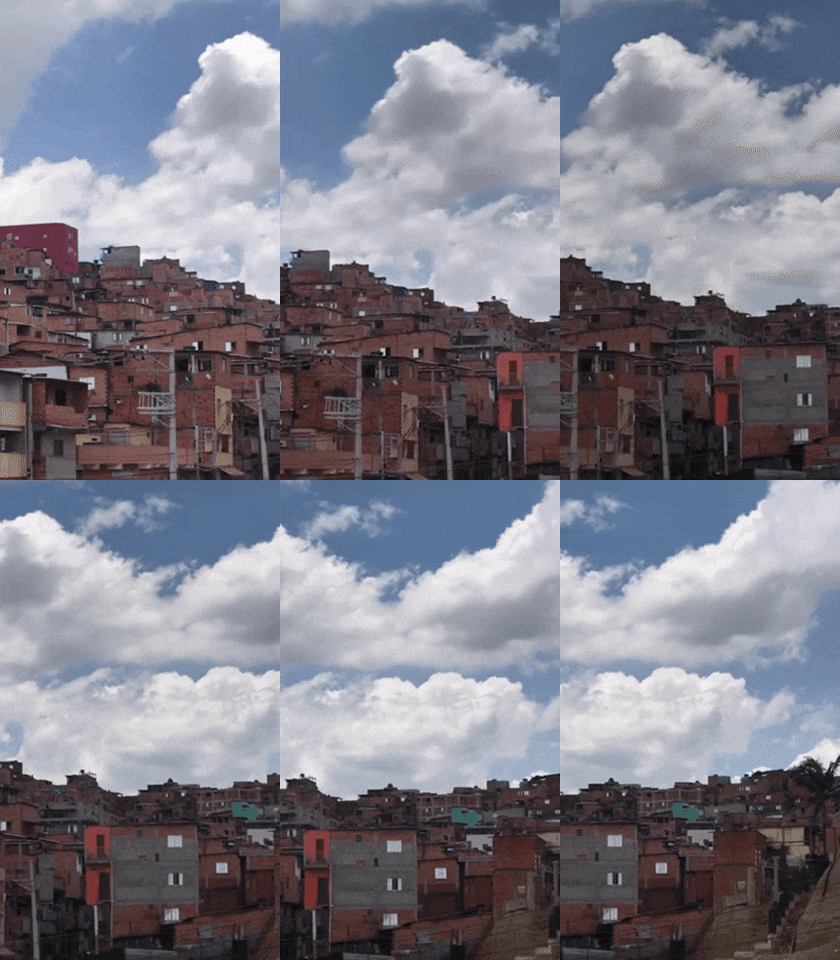
As someone who lived in Brazil for six years, although fortunately that was not my own reality, I know better than most foreigners the scale and the characteristics of the favela or slum situation currently facing the country.
I am horrified every time reports appear in the media of tourists (Germans, Belgians, Americans…) visiting a favela in Rio as if it were a human safari, taking photos of the misery and enjoying the catastrophe. Some people might think that, at least, it is economically beneficial for the neighbourhood, and that these people are spending this money in the area and not somewhere else, but for me, it is morally problematic. Favelas should be something fix, not to enjoy.
The origin and expansion of this phenomenon is long-standing and complex. Sadly, the Brazilian government has not been proactive or responsible regarding the housing situation, and at many moments of the history, it seems that they encouraged the growth of these environments. The abolition of slavery in 1888, besides being extremely late, was not planned at all, and left the black population free, but isolated without any resources. When they abandoned the farms and arrived in the cities, there wasn’t a place for them to live, nor any property to own, only the hills to build a future for themselves and their families.
Another lesser-known episode is the end of the Canudos War, when the soldiers went to the capital (Rio de Janeiro) to receive the land as a promised rewards and the government breached its promise. Those soldiers had to create their own housing, in the hills of Rio. Hills that saw how the population increased more and more in the following decades with massive waves from the poorest regions of the country.
Althought they are the most famous, surprisingly the highest number of people living in favelas is not in Rio, but in São Paulo. This is because, unfortunately, the situation is not a historical issue frozen in time, it is a reality that increases every year, with more than 16 million people living in more than 12 thousand communities.
But before continuing talking, one important question, what exactly is a favela? Technically, it is a neighbourhood where people live without property deeds, lacking public services, with poor infrastructure and with environmental risks. When we think of different solutions for this situation, this characteristics show the complexity of the issue, both in terms to maintaining or removing the houses. Legally, these people are not owners of their houses and it is very difficult to demonstrate the ownership and the value of the property. The installation of public services like electricity, water and sewage now, with all the existing constructions is infinitely more expensive and difficult than in a new neighbourhood. And it’s essential not to forget the XXI century villain, climate change. These buildings have been built many times in the worst possible areas, with risks of landslides, floods and other disasters.
However, if these points are not challenging enough, we have yet to discuss the trickiest aspect, the criminal gangs. Data shows that more than 80% of the country’s favelas in some states are under the control of criminal groups, half of the territory by militias and the other half by drug lords, like the Comando Vermelho. These groups control every aspect of the inhabitants’ lives, from jobs, energy, internet, to moral precepts. Violence over the control of specific areas or between the criminals and the police is a daily reality, with reports of deaths from stray bullet (often children) being something common in the media.
The population of these neighbourhoods lives, in the majority of cases, in poorly built houses, unable to travel to another neighbourhood, and forced to pay a 25% tax on all kinds of services (energy, gas, internet, TV…), and even so, the possibility of a mandatory removal is scary for them. Because all their lives are there, all their savings, the relatives, the long-term neighbourhoods… sometimes until their jobs, and those things are not easy to replicate in other place, from night to day. In addition to that, the possibility of paying a rent or to buy a house in another area of the city, many times would be impossible, pushing this people to extremely distant places or directly out of the city, causing the loss of the jobs, as well as the dismemberment of the social tissue.
But when the solution chosen is not the demolition but the pacification and the improvement of public services, unfortunately complications could also appear. One example of this situation is the Vidigal favela, in Rio de Janeiro, close to rich areas like Leblon. Before the World Cup in 2014 the police went into the favela and the drug dealers abandoned it, creating the perfect environment for rising prices and gentrification of the area. When tourism rose, middle class and hotels began to buy buildings, and by consequence the local population couldn’t pay for them anymore (the rent price increased until 300%) and was ‘‘expelled’’. And the worst part? The peace doesn’t last long, shortly after the State of Rio went bankrupt and the militarisation of the area was abandoned, causing the return of drug lords.
So, the question is: if the improvement of the neighbourhood is problematic and the relocation even more, what should be the answer? The residents are scared of the gangs and the militia, but in the hills there is their family, their identity. It is a place with prices more realistic, close to their jobs in rich neighbourhood or in the favela itself, with social and sport projects…many more aspects than in a house in the suburbs would be impossible to replicate.
Unfortunately, there is not a simple answer, and in many cases there is people like me, who has never lived there and doesn’t know the details, who want to get rid of everything there, sometimes with racist and aporphobic filters. Perhaps giving property titles to the inhabitants would help, perhaps it was not enough Who knows? Maybe the first step is simply talking about it.