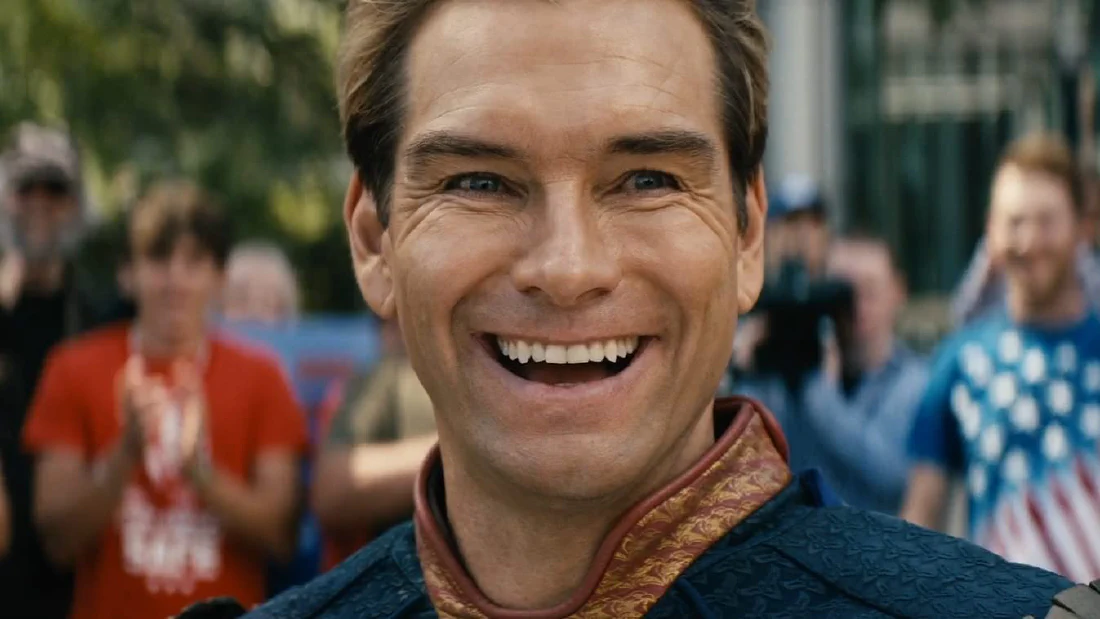
There is a scene in the first season where Homelander lets a plane crash. He could save everyone on board. He doesn’t, because he can’t carry the plane alone and can’t bring himself to admit it. He stands still in the sky, watching people die, and flies away. It is one of the most disturbing scenes in the series. Not for the blood. For the cowardice. There is no gore. There is a powerful man who chooses his image over the people, and the viewer understands everything about him in thirty seconds. The scene works because it is contained. Because it trusts the viewer. Because the horror is in the subtext, not on the screen. The series that produced that scene and the series that exists today share the same name. They don’t share much else.
The Boys was always excessive. That’s not the problem. The problem is that the excess was, at the beginning, a language. Then it became the argument. In the first and second seasons, the violence and the absurdity had a function. One example: Robin (remember her?) dies in the first few minutes in a completely banal way, run over without ceremony, and the series is saying something directly: in this world, you don’t matter. Every extreme moment pointed outward from itself. Starting from the third season, the extreme moments started pointing inward. The question stopped being “what does this mean?” and became “how far can we go?” These are different questions. The second one has no satisfying answer, because the limit can always be pushed one more centimeter. And it was.
The series built a very specific cultural identity. The one that does what Marvel doesn’t have the courage to do. The uncensored series. The adult series. That identity became a prison. When you become famous for breaking limits, the limit becomes the product. You can’t have a quiet episode. You can’t resolve a character without it seeming like weakness. You can’t trust an emotion without covering it with dark humor right after, because direct emotion seems too naive for a series that prides itself on being cynical. The result is a series that has learned to imitate itself.
The third season still works. Not because of what it shows, but because it has a real emotional center. That scene where Homelander makes a teenager jump off a building because he had just learned of Stormfront’s death and, in a fit of pure selfishness, decided that if he was suffering, no one else deserved to be saved, those moments still save the series with their unpredictability. In the fourth season, equally or more extreme scenes happen and simply… end. Without echo. Without weight. The camera moves on as if nothing happened, because nothing happened, dramatically speaking. Shocking is easy. Making the shock mean something is the hard work. The series outsourced that work to the viewer.
Before anything else I want to make one thing clear. Antony Starr is an extraordinary actor. That needs to be said, because what follows is not about him.
Homelander worked as a character because he is unpredictable. The terror of him comes from not knowing what will trigger a reaction, from sensing that beneath the performance there is an unstable void. That works when there is contrast. When there are moments where he holds the impulse, where the mask holds, where the danger stays latent. The series, across the seasons, has been eliminating the contrast. Every Homelander appearance needs to be more disturbing than the previous one. Every season needs to have the moment where he crosses a line the previous season didn’t cross.
True horror does not scale linearly. It depends on rhythm, on silence, on anticipation. When everything is extreme, extreme becomes the norm. And then the most terrifying character on television starts to seem predictable, because you know he’s going to do something horrible, the only variable is which. The series has turned its best character into a spectacle. And spectacles wear out.
The Boys criticizes the spectacle by being the spectacle. It criticizes addictive entertainment culture by producing addictive entertainment. It criticizes heroes who perform virtue while performing cynicism. In the early seasons, that tension was productive. The series lived inside the contradiction it was analyzing, and that generated something honest. Vought sold manufactured images while the series showed what lay beneath. There was a gap between what the world of the series believed and what the viewer saw. That gap was the argument.
The fifth season for me is just as bad as the fourth. It seems they can’t go five minutes without showing something absurd or grotesque. Kiriko has to randomly announce she’d love to eat pussy, the theater director has to deliver a funny line after a fish enters his ass and kills him, the show has to feature Butcher’s dog with a sexual fetish for Homelander. Why? For the record, I’m writing this with only one episode left before the series ends, and I doubt that episode will salvage this disaster.
But not everything is bad. Without major spoilers, there is one episode focused on Firecracker. Well, only the first third, but there is tension, writing, dialogue… and then the second third was exactly what I was talking about, the dog fucking a Homelander plushie because why not. The runtime of both parts was exactly the same. The absurd is the norm, and the dramatic moment is the exception.
But anyway. Nothing will get it out of my head that this bet on absurdity is a top-down decision from Amazon, which once again throws any audiovisual production it makes in the trash. Congratulations to everyone involved.