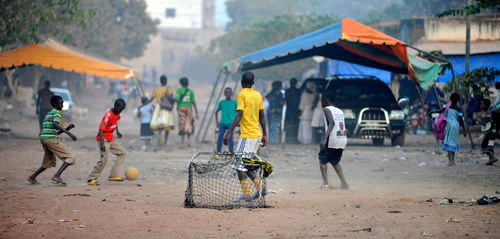
In the majority of cases (excluding countries like China, India and, of course, the United States), football is the king of sports, the most popular, the most watched and by far the most profitable of all. This popularity provokes that, for many children, football is the main option to play with classmates and friends and the perfect choice when the parents want to pay for a more ‘‘professional’’ structure for the development of kids’ skills.
The money moving inside football is huge and, without doubt, growing fast. The capillarity of the sport in big cities and small towns, with fields and lessons for all ages and prices assures a vast offer that makes it easy to practice and grow in the football world over the years. For many families, especially in poor countries, the possibility of a successful career in football works as a powerful incentive to encourage and support the child’s dedication to the sport, often, above their schoolwork.
The number of children and teenagers officially affiliated proves the supreme popularity of the sport in some countries. In Spain there are more than one million minors registered, in the United Kingdom there are over 1.5 million, 900,000 children in Italy and 550,000 in Brazil (with so many more in unofficial Youth Academies). Those are giant numbers and obviously, only a minuscule proportion achieves any kind of success in this area. These kids and their families spend years of effort, time and money chasing a dream of glory and riches that in the majority of cases becomes ashes. For example, a study based in Spain, proves that only 0,15%, or 1500 out of all registered footballers corresponds to the two main categories. In England, the journalist Michael Calvin found that only 0,012% of 1.5 million children will play at the Premier League level in the future. Sadly, a similar proportion of success is found in Italy, Brazil and many other countries. The illusion of improving life is real, with aggressive marketing behind it, but the reality is so much less bright. The big numbers in the elite of football today, with purchases of tens of millions of euros and weekly salaries with six figures, give a wrong idea of the real standard. In Brazil, for example, official statistics have found that around 80% of the professional players earn less than two minimum wages (approx. 550 euros per month). That is the final ‘‘prize’’ after having abandoned their studies as teenagers and with zero preparation for the market in the future.
Because yes, unlike other sports, like in the NBA, where it is mandatory to have finished at least high school to enter, in the football world it is normal to start playing for the main team when you are still a teenager, and the studies remain in second place. And if not having studied enough years when you arrive in the elite it is a problem, it is much worse when you don’t make it. The typical story-line of a football career doesn’t speak about those that didn’t make it, who have spent 10-15 years fully dedicated to their ‘‘career’’ and enter adult life and discover that no big club wants them, something because of a lack of quality, sometimes because of an injury.
This could be mentally and economically devastating for a young boy. A tragic emblematic case happened a few years ago in England. Jeremy Wisten was a brilliant promise who played in Manchester City since he was 13 years old, but unfortunately had a severe injury at 18 years old, and as he didn’t achieve a full recovery of his quality as a player, the team decided to terminate the contract. After months of trying to find another club without success, Jeremy decided to commit suicide. Cases as sad as this prove that, in football, it is not only the financial part that matters, but also the mental health. The person’s identity is tied to his role as a football player, and when that fails, the young man no longer knows who he is. Depression and anxiety are much more common in this field than in the general population, and dramatically high after being dismissed by a club, and in many cases nobody talks about it, nobody helps him.
Because the pressure to succeed in football starts very soon, usually inside their own family. Something that begins as a game, soon could become the main source of money for a poor family, with the young boy unable to quit anymore, though he doesn’t find pleasure playing. There are parents who get into debt, sell properties or borrow money from relatives for the promise of a career, as in known cases of African families. The line between the agent and the scammer is thin.
Recently FIFA has implemented a rule to avoid the purchase of young boys from the poorest countries to European countries. In theory, it is forbidden to sign a contract before the age of 18, but in many cases, like Vinicius Junior or Endrick recently, it is possible to buy their ‘‘future economic rights’’ when the boy is a minor, he continues playing in the same team for one or two years, and on his eighteenth birthday travels to Europe. The pressure on these players is huge, with international journalists and the social media following every step, where any error or injury is forbidden.
Another polemic strategy used by the clubs is to ‘‘contract’’ one of the parents in the club or at a friendly company with a huge salary and in this way, the teenager can travel to the country many years earlier.
In summary, despite the attempts to regulate it, football today could be a ruthless industry that allows a privileged few to become millionaires at the expense of leaving others by the wayside, without money, preparation, future and mental health, an authentic modern factory of broken dreams.