I finished the second season of Daredevil: Born Again. What a season, ladies and gentlemen! Acting, writing, action, everything. But don’t worry, no spoilers here. I won’t even really talk about the show. Let’s set aside the audiovisual material for a moment and focus on the world of the ninth art: comics.
Before that, I want to tell a story. In 2004, I had just moved and, naturally, as a nine-year-old you need to find your footing in a new reality. Near my new home lived a woman who spent countless hours tending her personal garden. Sometimes alone, sometimes accompanied by her grandchildren, who occasionally stayed at their grandmother’s after school, as was normal for kids with a widowed mother. The youngest, Bruno, my age, was the first one I met. Back then in Brazil, in working-class neighborhoods, it was normal to use the street itself as a football field. Two flip-flops marked the goalposts. The sidewalk marked the sideline. Another era. Bruno, an extremely sociable kid and a football fanatic, showed up on the first day asking if I liked the sport. It didn’t take long before we had a group of four friends playing football every day, rain or shine. The second brother, Breno, two years older, was the exact opposite: closed off, introverted, always reading “something,” it never even crossed our minds that he might play football with us. In short, the nerd at a time when being a nerd was seen as a problem.
One day I saw him reading a comic. I don’t remember exactly which one. I asked what it was and he explained: how it worked, monthly issues, character events. In very little time we were already organizing our small comic-book “reading club” at the public library. Since we were poor, a comic was a luxury we couldn’t afford. So we started selling small handsaws my grandfather made, from which we earned a 20% commission. We went out with the others to sell them. I still remember not knowing how to carry them well and always ending up with a bleeding leg from the sharp teeth hitting it as I walked. What did I do with that little money I managed to earn? Well, buy comics (and chocolate to impress certain girls). That’s how I started collecting Spider-Man stories, both in the regular series and in Marvel Millennium. A few months later I found issue number 3 of Daredevil (Brazilian numbering) at a newsstand and decided to buy it.
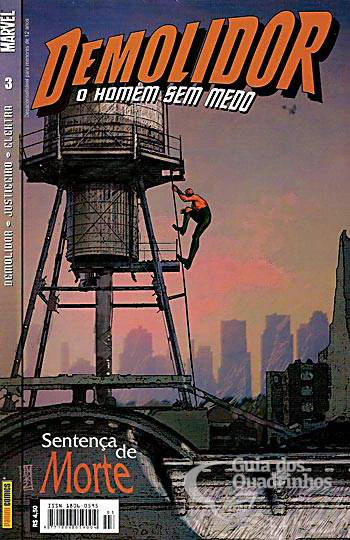
In Brazil, unlike in the United States, the comics market at the time was more limited. Having dozens of monthly issues available was impossible. What publishers did was bundle several American comics into one, more “sellable” volume called a Mix. The Daredevil issue number 3 in question collected Daredevil (1998) #40, Punisher, The (2001) #26, and Elektra (2001) #25. Even at ten years old, they were already heavy stories for my age. Today, more than twenty years later and thousands of comics read, I still remember closing that issue and being left with a strange feeling, not of relief, like when the hero wins in the end, but of weight. Of something having truly happened. That was what I wanted to read as an adult. It took me a while to understand why.
What caught my attention in those stories was simple, though I didn’t have the vocabulary to name it at the time: the characters truly suffered, and nothing ever resolved completely. Matt Murdock came out worse in almost every issue. Not gratuitously, there was weight, consequence, a feeling that this man was carrying something without end. It took me years to understand why that held me more than other stories.
The answer I found, after thousands of comics read, is this: certain characters are built on contradictions that have no solution. And that changes everything.
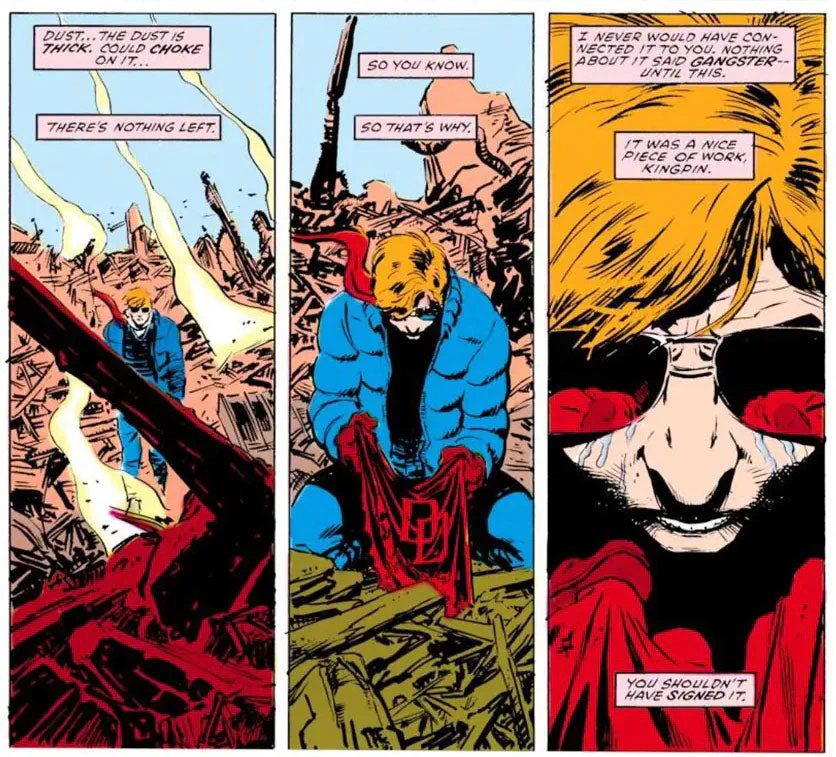
Take the most obvious example. Born Again, by Frank Miller and David Mazzucchelli, published between 1986 and 1987 in the pages of Daredevil, is considered by many, myself included, one of the greatest comic book stories ever written. The Kingpin discovers Matt Murdock’s identity and systematically destroys his life: strips him of his law license, burns down his apartment, undermines his relationships, literally reduces him to the streets. And you know what’s remarkable? It’s not the destruction. It’s that when Matt finally pulls himself back up, there is no clean victory. The Kingpin still exists. Hell’s Kitchen is still Hell’s Kitchen. The law still fails the people Matt defends by day while beating them at night to “protect them.” The central contradiction, a man of faith who commits violence, a lawyer who doesn’t trust the system he represents, is never resolved. Miller doesn’t resolve it because it cannot be resolved. It is the very reason the character exists.
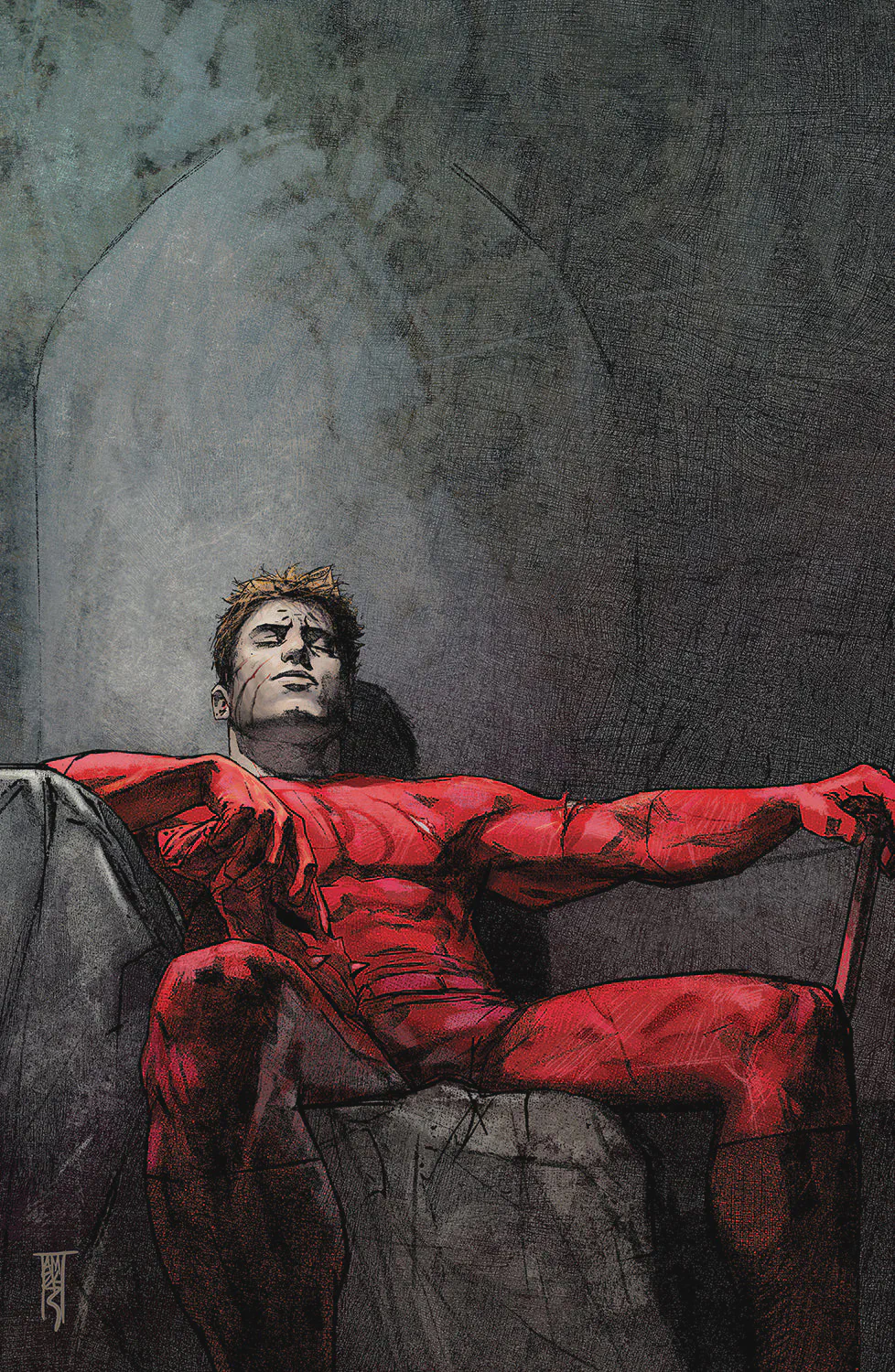
Batman operates by the same logic. In The Dark Knight Returns, Miller shows an aging, retired Bruce Wayne watching Gotham deteriorate. He comes back. And why? Not because he’s going to win. Gotham has no solution. The criminals won’t stop. The city will keep being the city that killed his parents. Bruce knows this. The reader knows this. And yet he puts on the suit because the alternative, not trying, is unthinkable for who he is. It’s a Greek tragedy with a cape. Scott Snyder understood this perfectly in Court of Owls: the revelation that Gotham has always been corrupt, that Batman’s war may be even older and deeper than he imagined, doesn’t paralyze the character. It fuels him. The impossibility is the fuel.
Now let’s compare the Flash. I read the Flash in its entirety. From the Golden Age to Rebirth. And I’ll be honest: the only run that held me with any consistency was Mark Waid’s with Wally West. And that’s no coincidence. Waid did something that’s rarely done with the character: he created an irresolvable contradiction. Wally West can never be Barry Allen. He can wear the name, the symbol, the speed, but the shadow of his predecessor doesn’t disappear. Every time Wally saves someone, part of the city is still thinking about Barry. That has no narrative solution. Wally can become his own Flash, and he does, but the tension remains structural. And that’s exactly where the writing elevates. Outside of that run, what do we have? Races against villains, events that reset the status quo, the weight of legacy mentioned but never explored with depth. Barry Allen himself, in most stories, is a character without a constitutive wound, a decent man who wants to save everyone, and does. The conflict is always external, never foundational.
It’s easy to say that power level is the villain of the story, that Superman is hard to write because he’s invincible. But that doesn’t hold up. In the later issues of the New 52, Superman lost his powers. The writing remained weak. But the most revealing case is Superman: Grounded by Michael Straczynski. The premise was exactly this: humanize Superman, bring him closer to ordinary people. He drops the heroic flights and walks across the United States, talking with anonymous citizens, trying to reconnect with the humanity he had been protecting from a distance. It was a direct attempt to solve the problem, and it failed. Not for lack of intention, but because the initiative revealed what was missing: it wasn’t physical distance between Superman and the people, it was the absence of an internal conflict that no walk could resolve. In the end, Clark Kent was still a good man, from a good family, with clear values, who wants to help. That’s admirable. It’s also dramatically limited.
The Death and Return of Superman, in the nineties, is another symptom. Commercially it was a phenomenon, the issue that killed the hero sold out worldwide, became news outside of comics. But rereading it today, what we have is spectacle without substance. Superman’s death doesn’t dig into anything in him. It reveals no contradiction, exposes no wound. It’s an external event applied to a character who, structurally, has nowhere to bleed from the inside. The drama comes from outside because there’s nowhere to draw it from within.
Batman and Daredevil don’t need that kind of effort. The tension is in their DNA. Every new writer who arrives finds the open wound waiting. Ann Nocenti, undervalued in terms of public recognition, took Daredevil during a phase when he was psychologically destroyed and explored the relationship between guilt, desire, and identity in ways that still feel daring today. Brian Michael Bendis turned Hell’s Kitchen into an urban noir where the Kingpin and Matt Murdock were mirrors of each other, two men building identities out of lies. Chip Zdarsky, more recently, took that same wound and did something that seemed impossible: found a new angle. Matt Murdock deciding he needs to move beyond violence, and then returning to it, because he simply cannot stop. Completely different writers, decades apart, the same central friction.
The best villains for these characters work for the same reason. The Joker isn’t just a criminal with a clown theme, he is the argument that the order Batman defends is an illusion. Every confrontation between them is a philosophical debate about whether civilization has meaning. The Kingpin isn’t just a crime boss, he is what Matt Murdock could have become if he had abandoned the law and fully embraced power. Bullseye is Daredevil’s violence without the conscience. The villains are mirrors. They amplify the hero’s contradiction instead of merely threatening him physically. When a character has that kind of architecture, the story practically writes itself. Not in the easy sense, in the sense that the material is always there, waiting to be found.
I’m not saying that aspirational stories have no value. They do. Superman in All-Star is a powerful argument about goodness as an active choice, and it’s an argument the world needs. But there is a difference between the story that inspires and the story that stays with you, and characters built on irresolvable contradictions tend to do the second thing with more efficiency and for longer.
That’s why Batman has twelve brilliant runs and not two or three. That’s why completely different writers, in style, in era, in intention, can pick up Daredevil and do something worth reading. The wound is there. A good writer only needs to know where to press.
And that’s why I loved the feeling of having watched the second season of Daredevil: Born Again. It was familiar. It was the same feeling as when I closed that issue number 3, twenty years ago, not quite knowing what I had read but knowing I wanted more. Matt Murdock will keep losing. He will keep getting back up. And writers will keep finding, in that endless cycle, enough material for works that last decades. That’s the secret: it’s not the powers, it’s the wounds.