I’ll start with a confession. When I was a kid we didn’t have money to buy VHS tapes. What we had at home were exactly two: A Bug’s Life and Shrek 2. That was the entire catalog. So I watched A Bug’s Life a number of times I honestly cannot estimate, enough that I still know the Brazilian dub by heart, line by line, and could probably recite it over the muted film without missing a cue.
Now I’m a father. Yesterday I put the film on in the background while I played with my daughter, almost three months old, on my lap. It was supposed to be noise. Instead I caught myself actually watching it, for the first time as an adult, and noticing that there is a lot more going on in that colony than the meme gives it credit for. You know the meme: A Bug’s Life is the Communist Manifesto in animated form. Ants produce, grasshoppers extract, workers of Ant Island unite. It’s funny because it isn’t wrong. It’s also the least interesting thing about the film.
So let me take the meme seriously for one paragraph and then set it aside.
A Bug’s Life can easily be read as a story about oppression, and that reading holds: the ants produce, the grasshoppers extract, and liberation becomes possible the moment the colony realizes it outnumbers its rulers a hundred to one. Hopper says it out loud. But there is another conflict running underneath the political one, and I think it’s the better one. Before Flik ever challenges the grasshoppers, he is already at war with the ants. The colony is organized, efficient and completely dependent on repetition. Flik interrupts routines, invents machines nobody asked for, causes accidents and fails, over and over, to behave like a useful member of the system. The character who ends up saving the colony is exactly the character least capable of functioning normally inside it.
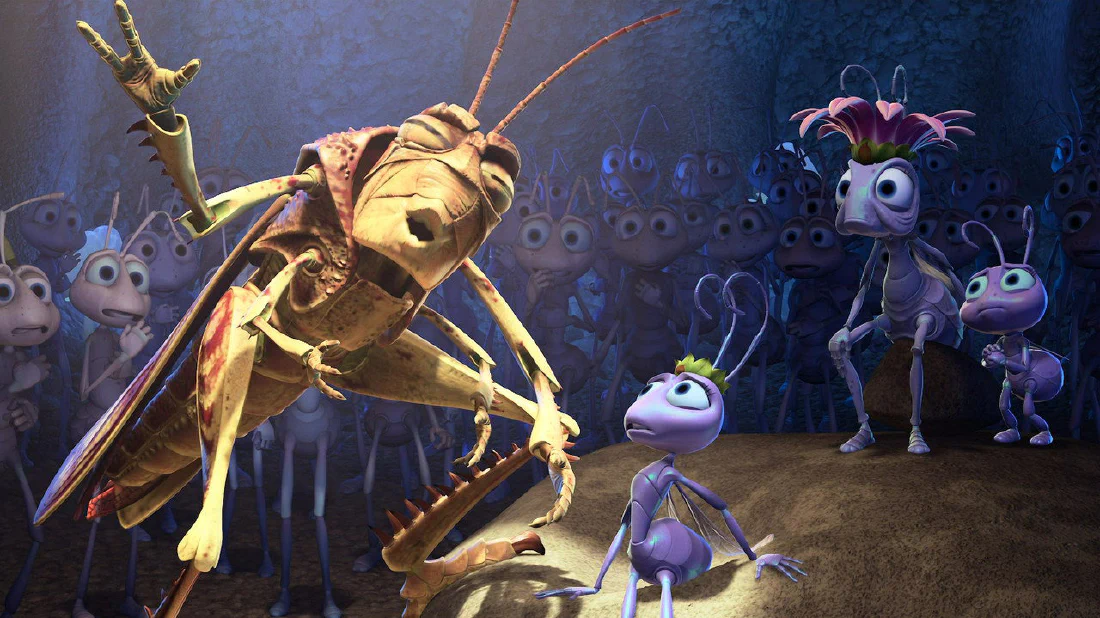
This does not mean the film is a celebration of chaos, or of the misunderstood genius. Flik is genuinely dangerous at times. His inventions fail, his decisions create new problems, and the other ants have perfectly rational reasons to distrust him. The tension is more interesting than “everyone thought he was crazy, but he was right.” Flik’s weakness and his strength come from the same place: he cannot accept an existing procedure as inevitable. Where the colony sees a routine, he sees a problem that could be redesigned.
I want to take that tension seriously, because I think the film has something closer to a theory than a moral. To get there I need to borrow a few concepts from places that have nothing to do with cartoons: reinforcement learning, organizational theory, evolutionary biology and a French anthropologist. Bear with me.
The Colony Is Not Stupid
Let’s start by defending the ants.
The offering to the grasshoppers happens every season, the same way, with the same result. The Queen has a line about it that could be printed on a mug: they come, they eat, they leave, that’s our lot in life. Read as politics, that’s resignation. Read as strategy, it’s something else. The colony has found a procedure that keeps everyone alive, and it executes that procedure with a precision that is honestly beautiful to watch. That line of ants carrying grain in the opening minutes looks like oppression if you’ve decided in advance it’s an oppression story. Watched on its own, it’s a picture of a system that works.
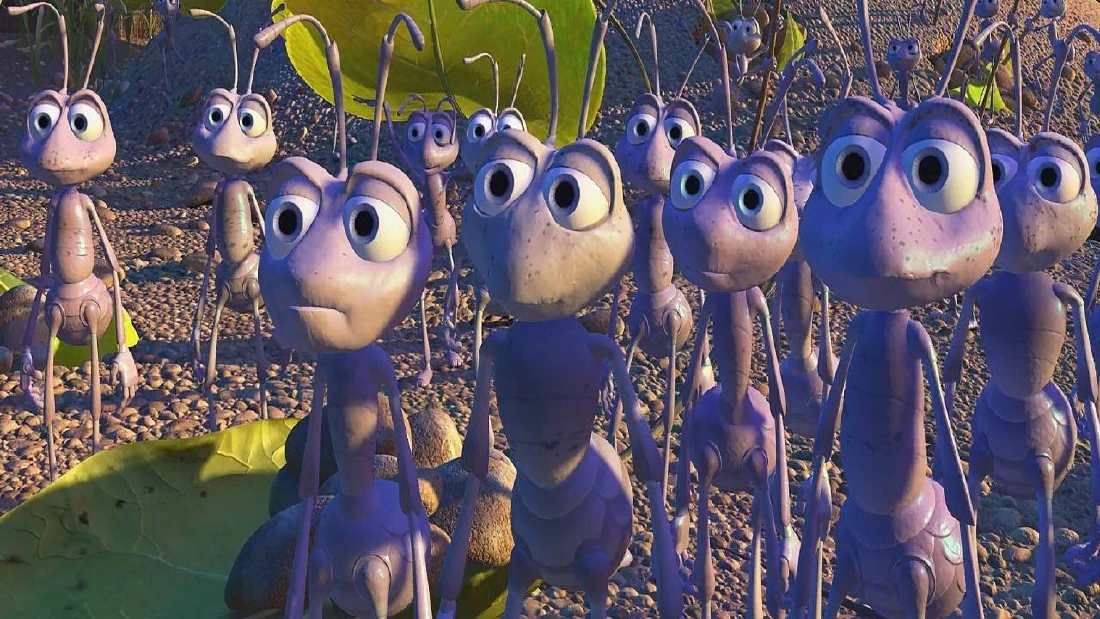
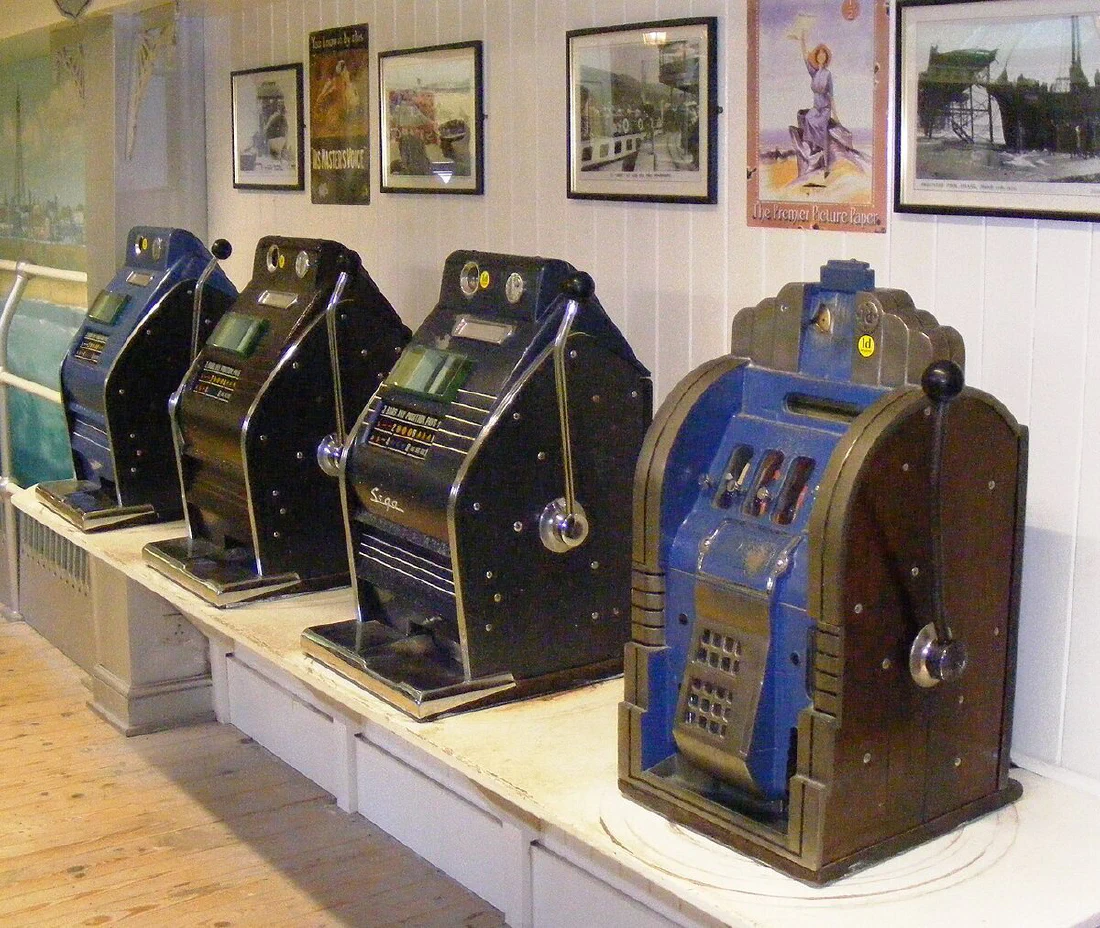
In reinforcement learning there’s a name for this: exploitation. You have a strategy you know pays off, and you keep running it. The opposite is exploration: you spend resources on an alternative that might pay better, might pay worse, and will almost certainly cost you something before you find out which. The textbook version is a row of slot machines. You’ve found one that pays reasonably often. Every coin you put into a different machine is a coin not going into the one you trust, and most of those coins are lost. Yet if you never try another machine, you will never learn whether a better one exists. The whole problem is deciding how many coins to waste.
James March wrote the paper that made this a problem for organizations rather than gamblers, in 1991, and his point is sharper than the usual “balance is good” summary. Exploitation pays soon, reliably and close to home. Exploration pays late, unreliably and often to somebody else. Because of that asymmetry, any system that learns from its own results will drift toward exploitation on its own. Nobody has to decide it. Every successful harvest makes the procedure look a little more like the only possible procedure, and every failed experiment makes experimenting look a little more like a waste. The colony did not choose to stop imagining alternatives. It got there by being good at what it does.
That is the ant colony to the letter. And the film gives the drift a face, because Hopper understands the mechanism better than anyone on Ant Island. His speech to the other grasshoppers is not about food. The ants outnumber them a hundred to one, and if the ants ever figure that out, “there goes our way of life.” The routine keeps the colony alive, and it also keeps Hopper in charge. Keeping the ants in exploitation mode, one harvest at a time, is the whole point of the annual visit. A colony that only ever repeats is a colony that never counts itself.
And Then There’s Flik
Flik is exploration with legs, and something close to a pathology of it. He cannot walk past a routine without wanting to rebuild it. He builds a harvester nobody requested, in the middle of the one process the colony absolutely cannot afford to disturb, and the harvester works, mechanically. It cuts grain. It also knocks the entire offering into the stream, which is the event that sets the whole story in motion. Hopper doubles the demand. The colony now has a deadline it cannot meet with the old procedure.
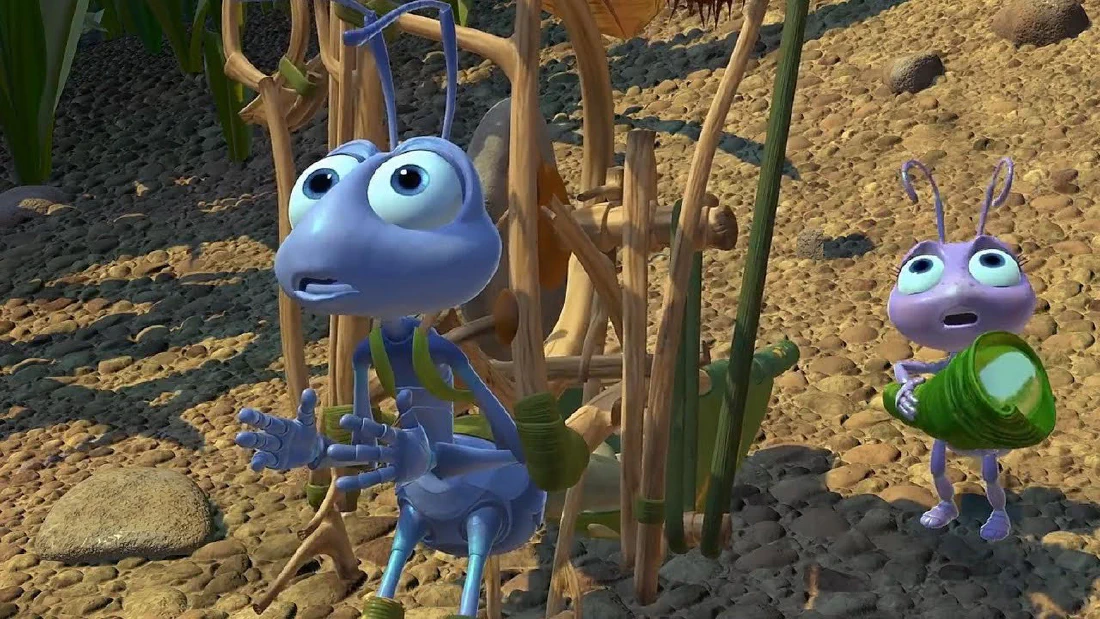
This is the part the “misunderstood genius” reading skips. Without Flik there is no crisis. The colony’s distrust of him is not prejudice. It’s accounting. His costs land immediately and with certainty, on everyone. His benefits, if they ever arrive, arrive later and in a world that hasn’t happened yet. Most colonies that keep a Flik around pay for him every season and get nothing back. The film shows us the one season where the account balanced, and it would be dishonest to pretend that’s the normal outcome.
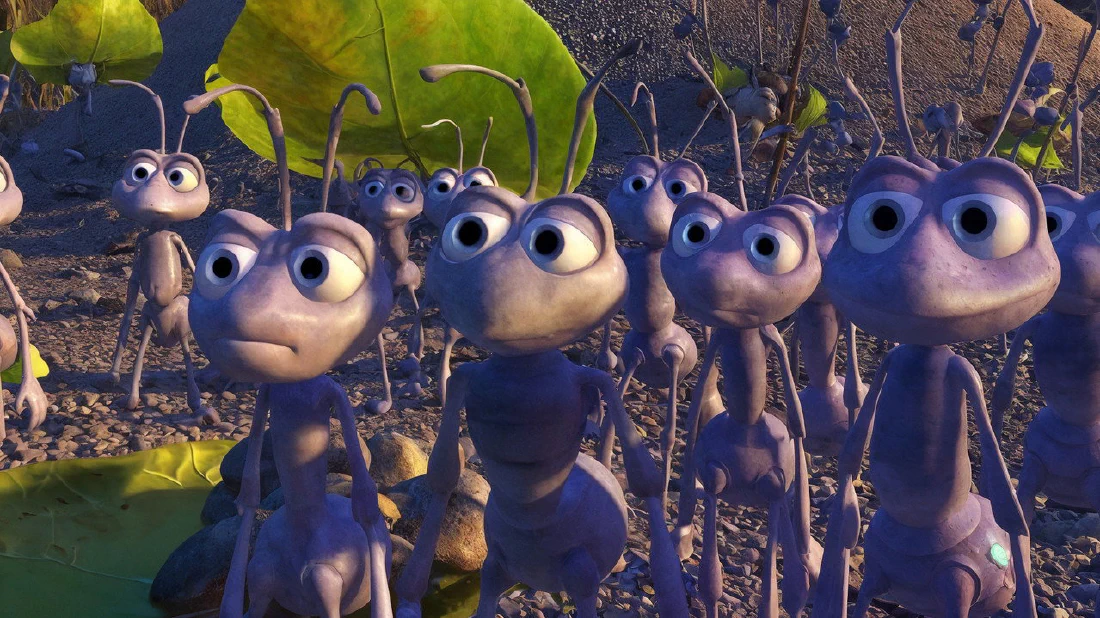
There’s a term for what Flik does with the harvester. Charalampos Mainemelis calls it creative deviance: continuing to work on an idea after you’ve been told to stop. It’s the narrow, annoying overlap where somebody with authority said no and the person kept going anyway. Management writers have a whole family of names for this neighborhood, positive deviance, constructive nonconformity, and they all wrestle with the same problem. An organization can’t separate the deviance that produces its next breakthrough from the deviance that produces its next disaster, because at the moment it happens, it’s the same behavior. It looks the same from the outside. It looks the same to Atta.
Normal Science, With Antennae
Thomas Kuhn gave us the vocabulary for how mature systems handle this. In The Structure of Scientific Revolutions he describes normal science as puzzle solving inside a set of assumptions nobody questions, and he is careful to say that this is not a flaw. Puzzle solving inside fixed assumptions is how a field gets anything done. The assumptions are what make the puzzles solvable. Kuhn also notes that the people who overturn a paradigm tend to be young or new to the field, less committed to the rules, because they have less invested in them.
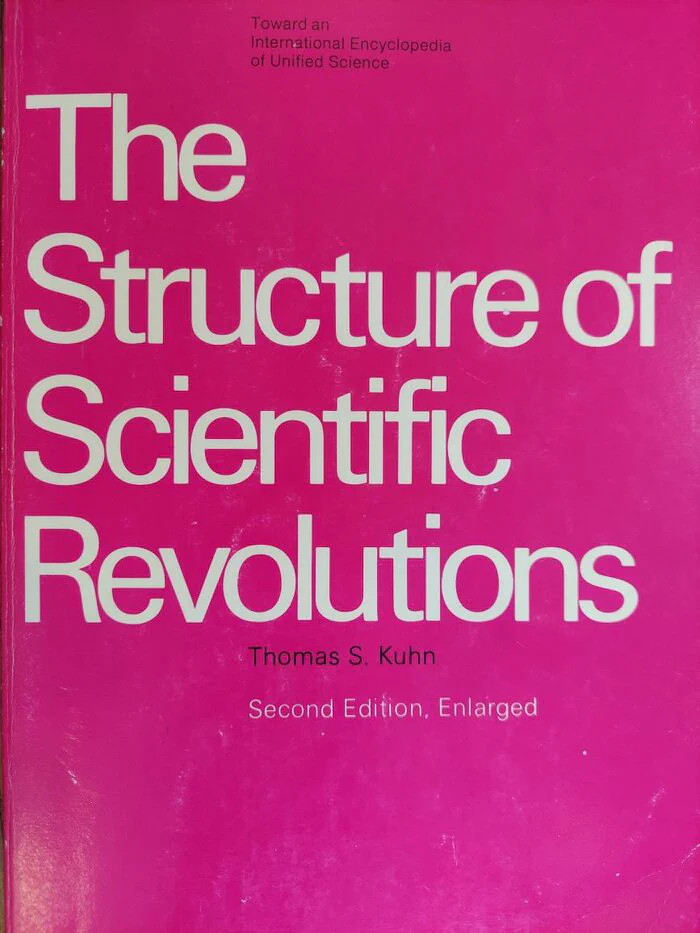
The colony’s paradigm is one sentence long: the grasshoppers come, we feed them, they leave. Everything the colony does is a puzzle solved inside that sentence. How much grain, by when, carried how. Flik’s harvester is not a puzzle solution. It is what Kuhn calls an anomaly, a result the paradigm can’t absorb, and the colony treats it the way any mature field treats an anomaly: as an error, as Flik’s fault, as something to be cleaned up so the puzzle solving can resume.
What turns an anomaly into a crisis, in Kuhn, is when the paradigm stops being able to deliver. Hopper’s doubled demand is that moment. The old sentence cannot produce twice the grain in half the season. Only then does the alternative Flik has been carrying around, that maybe you don’t feed the grasshoppers at all, stop sounding insane and start sounding like a candidate. He didn’t become right. The environment moved to where he was already standing. That is a much less flattering story about innovators than the one we usually tell, and I think it’s the correct one.
The Circus, or Skills Nobody Ordered
Now the part of the film I like the most.
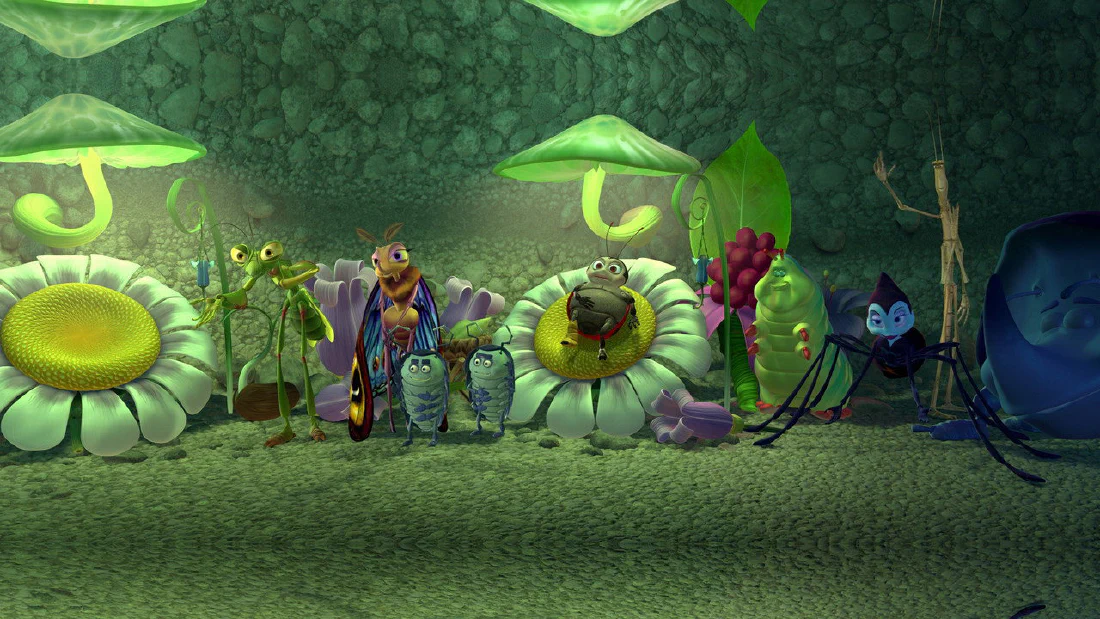
Flik goes to the city looking for warriors and comes back with a circus. He mistakes a bar brawl for combat, the troupe mistakes him for a talent scout, and both parties are so pleased with the misunderstanding that nobody checks. What arrives on Ant Island is a walking stick who is always cast as the stick, a male ladybug everyone assumes is female and who is furious about it, a caterpillar waiting to become a butterfly, a praying mantis doing magic tricks, a rhinoceros beetle presented as a ferocious beast, a black widow, and two pill bugs who speak no language anyone on the island knows.
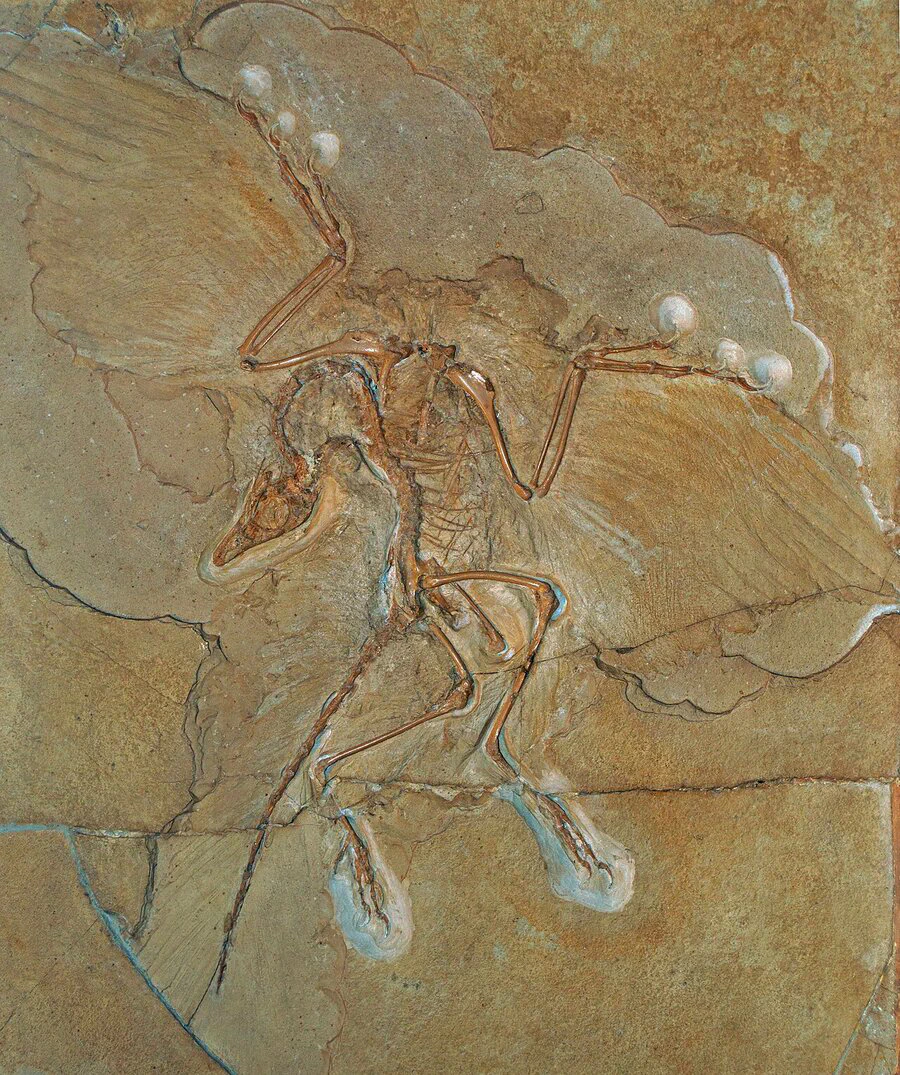
In evolutionary biology, Stephen Jay Gould and Elisabeth Vrba proposed a word for a trait that evolved for one job and was later co-opted for another: exaptation. The example everyone uses is feathers. Whatever feathers first did for the animals that grew them, and the honest answer is that the evidence points to insulation or display, they did not evolve for flight. Flight came later and used what was lying around. Nobody planned it. There was a body covered in a material that turned out to have a second use once the animal was in a different situation.
The circus bugs are exaptation as a cast of characters. Every skill they have was built for an audience. Then a real bird attacks Dot, and those same skills, placed in a situation with actual stakes, do work they were never designed for. Across the rescue and the finale, Francis’s nerve, Dim’s wings, Rosie’s silk, Manny’s disappearing act: none of it changes. The context does. The entertainment value they spent years refining was, all along, a set of capabilities with a second use, and nobody, least of all the bugs themselves, knew it until the environment asked a different question.
Notice that the film keeps doing this with information too, not only with bugs. The single most important fact in the plot, that Hopper is terrified of birds, does not come from Flik’s research or his ingenuity. It comes from Molt, Hopper’s dim brother, blurting out the story of the blue jay during the grasshoppers’ first visit, and from Atta remembering it at the right moment. A stray piece of gossip, dropped by the enemy, sat unused until a bird attack gave it a purpose. That is the pattern of the whole film: nothing is where it should be, and value comes from somebody noticing what the misplaced thing could do.
Bricolage
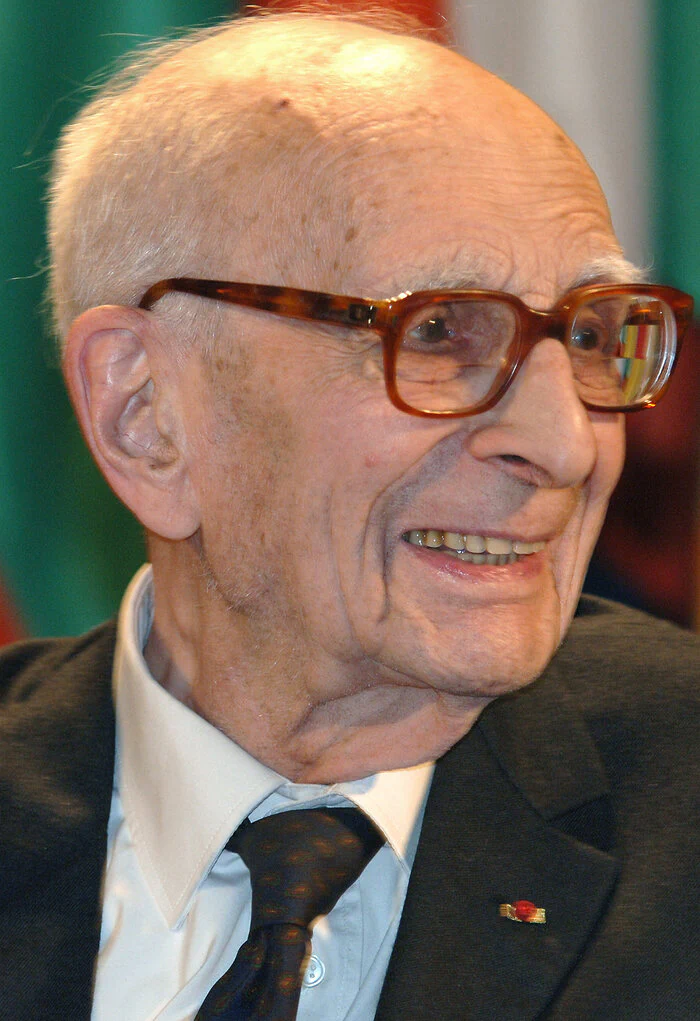
Claude Lévi-Strauss has a name for the person who works that way. In La Pensée sauvage he separates the engineer from the bricoleur. The engineer starts from the project and goes out to acquire the tools and materials the project requires. The bricoleur starts from a finite, heterogeneous pile of leftovers, things kept because they might come in handy, and asks what can be made from what’s there. Each object in the pile has a history, was made for something else, and is available for a new use precisely because it was never fully committed to the old one.
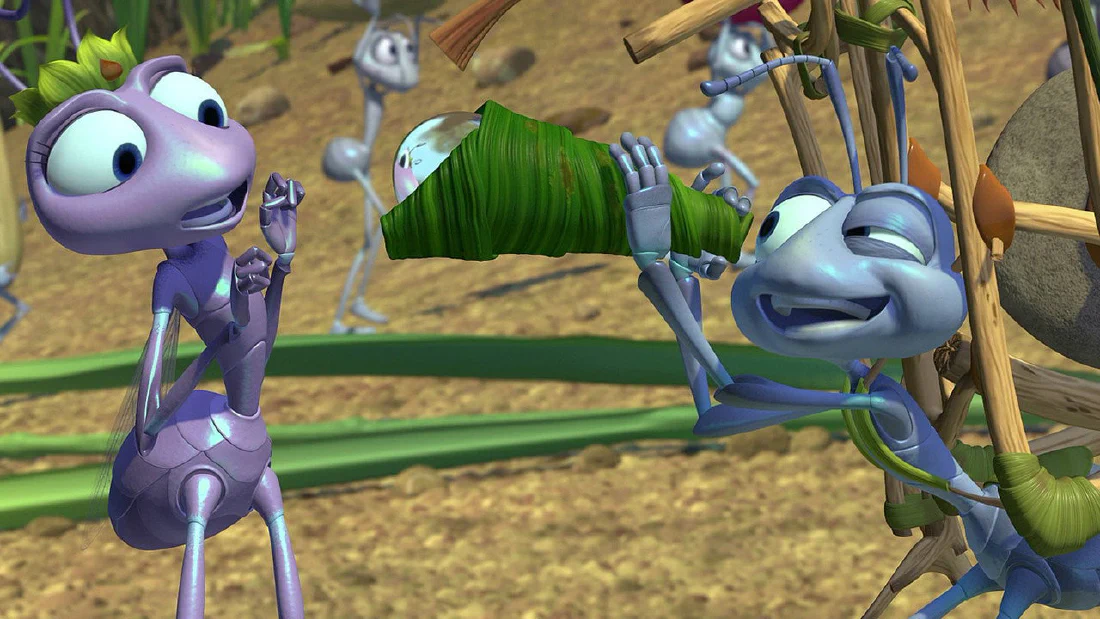
Flik thinks he’s an engineer. He leaves for the city with a project (find warriors) and a plan to acquire exactly the resource the project requires. What he actually does, every single time, is bricolage. A drop of dew in a rolled leaf becomes a telescope. A circus troupe becomes an army. A pile of leaves, twigs and whatever the colony can carry becomes a bird. He never once gets the tool he set out to get, and he never once fails to build something out of what he got instead. Recruiting the circus bugs is bricolage applied to people, a social bricolage, where the misfit uses other misfits, each one carrying a skill that was made for somewhere else.
And here is where Flik’s two halves join. The reason he sees a telescope in a dew drop is the same reason he can’t leave the harvest alone. He does not accept that an object’s original purpose is its only purpose. That’s an unbearable trait in someone standing in a supply line and an indispensable one in someone standing in a junkyard. The colony needed both, at different moments, and it took the film’s entire runtime for the two moments to line up.
Pay Attention to the Machines
The film has, I’m fairly convinced, an implicit theory of invention, and you can read it off the machines.
The first harvester works and fails. It cuts grain, and it destroys the offering, because it was built alone, dropped into a process that hadn’t agreed to it, and nobody was watching where its arm would swing. It is a solo prototype, tested in production, on the one day the colony couldn’t afford a test.
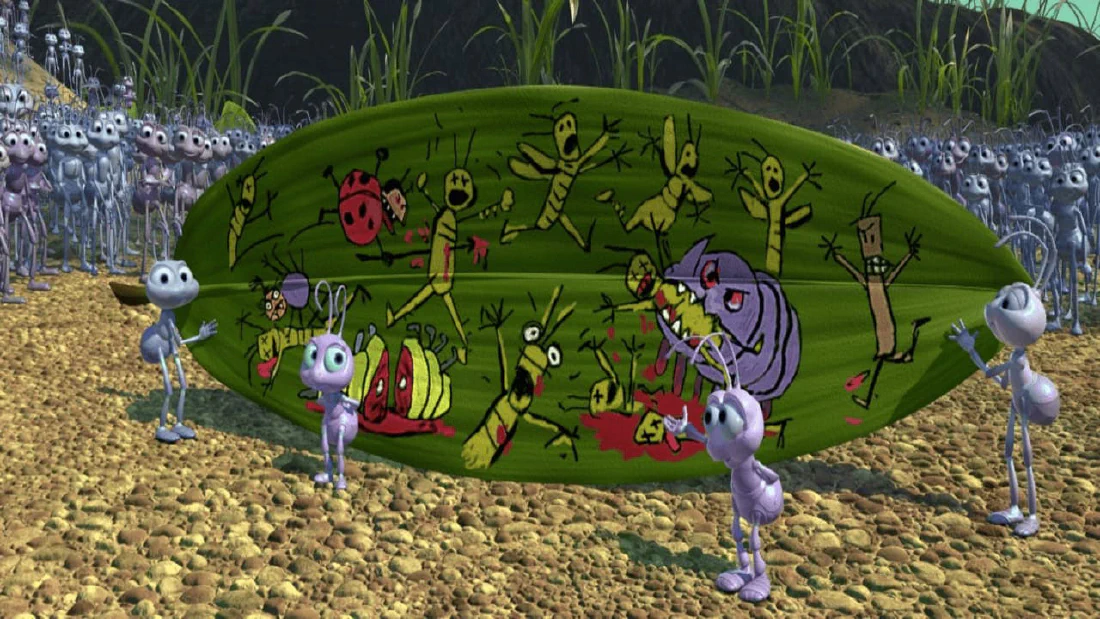
The bird is different in every way that matters. Flik designs it, but the colony builds it, and the build is the first time in the film that the ants’ talent for coordinated, repetitive labor and Flik’s talent for seeing alternatives are pointed at the same object. That’s the shot I’d frame: the whole colony gathered around a leaf with the bird drawn on it. Exploitation and exploration in the same picture, finally cooperating.
And then the bird fails too, but the failure is instructive. It works on the grasshoppers. It works on Hopper, for a moment. What kills it is a variable outside the model: P.T. Flea, chasing his troupe, sees a bird and sets it on fire. The invention had no defense against a third party acting on incomplete information, which is the risk every invention faces the moment it leaves the workshop. And yet the burning bird does the one thing no machine in the film manages on its own. It gets Flik to stop building and start talking. His speech to Hopper is the colony’s own numbers said out loud, and it works because the whole colony was already standing there. The bird failed and exposed the real weapon, which had been there the whole time.
Prototype, accident, improvisation, revision, cooperation. In that order. The film’s position on machines is narrower than pro or anti: a machine works when the system around it changes to make room for it, and fails when it’s dropped into a system that hasn’t. Which brings me to the ending.
Who Changes
The easy reading is that the colony finally listens to Flik. I don’t think that’s what happens.
Flik changes first, and more. He gets caught in a lie he chose to keep, gets sent away, and needs Dot to come find him and hand him back his own lesson, the one about the rock that is really a seed. When the plan collapses he doesn’t reach for another gadget. He reaches for the ants. He had to learn that the colony’s repetition was not the enemy of his ideas. It was the only thing that could ever execute them.
But the colony changes too, and the film is careful to show it. Atta takes a risk on a plan she doesn’t fully trust, then flies out to rescue the ant she banished. The Queen hands over the crown. And the very last thing we see of Flik’s work is a harvester, redesigned, being operated by the colony as part of the harvest. The tool got absorbed into the routine, which is a better ending for an invention than a monument. Schumpeter would probably call it creative destruction, but I think that’s too big a word for what happens here: the line isn’t destroyed, it gets a machine at the end of it. Exploration, once it paid off, was converted into exploitation, which is the only form in which a colony can actually keep it.
So the answer to “who changes” is both, and in a specific direction. The misfit learns that he needs the system to make his ideas real. The system learns that it needs a bounded amount of the misfit to have ideas at all. Neither side wins the argument, because the argument was badly posed.
Seen this way, A Bug’s Life is not only about overthrowing an oppressor. It is about a problem every stable society has to live with: stability requires rules, repetition and conformity, but transformation depends, more often than we’d like, on people who don’t fit those rules particularly well. A system where everyone behaves like Flik cannot survive a single harvest. A system made entirely of perfectly obedient ants may never imagine anything beyond what already exists, and will keep feeding the grasshoppers forever, on schedule, with beautiful precision. The deeper question the film raises is not whether a society needs order or chaos. It’s how a society keeps enough order to survive without quietly eliminating the kind of misfit it will, one day, need in order to change.
And that’s it. Until next harvest.
Film stills via TMDB. Archaeopteryx photo by Emily Willoughby (CC BY-SA 4.0). Claude Lévi-Strauss portrait by UNESCO/Michel Ravassard (CC BY 3.0). Slot machines and book cover from Wikimedia Commons (public domain).